Start the challenge

For women who are tired of being the one everyone asks

Discover the 5-Minute Practice That Lets You Say NO Without Long Excuses or Days of Guilt, in the Next 14 Days

You already know how to say no, to family, friends or your boss. It’s just that “yes” is a reflex, and it fires before your brain gets a vote. Reflexes can be retrained: one email a morning, one tiny action, one script, and you never turn into someone you don’t like.

Start the 14-day challenge $23

Five minutes a day · One-time payment · 30-day guarantee

4:55
Friday
Mom now
Honey, can you do Thanksgiving again this year? Everyone loves it at your place
Let me check and get back to you. You never have to answer on the spot.

Your phone lights up. It’s your mom. Or your sister, or the group chat, or your boss at 4:55 on a Friday.

You haven’t even read the whole message yet. But your throat is already tight, your face is going hot, and somewhere in there, you’ve already decided.

“Sure, no problem!”

Then you put the phone down and think: why did I do that again?

If you’re anything like me, it’s not because you don’t know better. You’ve read the books. You’ve saved the posts. You could write a perfect no for your best friend in about ten seconds.

You just can’t seem to say one yourself.

You’re not the only one. These are real words from women in online forums about people pleasing:

“I’m very aware of this tendency but it still doesn’t prevent it happening.”LoveShack.org forum
“I’ve tried to stop this but then feel guilty.”Mumsnet forum
“Previously, I’d panic and say yes to everything!”Mumsnet forum

Here’s what nobody told me for fifteen years: understanding was never the problem. You can’t out-think a reflex. It’s too fast. By the time your thinking brain shows up with everything you’ve read, the yes is already out of your mouth.

But a reflex can be retrained. Not with a big, brave confrontation. With tiny, slightly boring, daily practice, starting with a no so small it barely counts.

That’s what the 14-Day Yes Reflex Challenge is. One five-minute email every morning. One tiny action. One script, so you never have to invent the words while your face is going hot.

On this page I’ll show you:

Start the 14-day challenge $23

One-time payment · Instant access · 30-day guarantee


For fifteen years, I was the reliable one

Hi, I’m Jess.

I organized every office birthday for six years. Bought the cake, signed the card for everyone. I hosted Thanksgiving nine years in a row, and Christmas Eve too. I answered work emails at 11 p.m. because “it’ll only take a minute.” Class mom, bake sale, the name on every sign-up sheet nobody else filled in.

When I did try to say no, it took me twenty minutes. I once wrote a text to get out of brunch with my best friend that had three “sorry”s and a dentist appointment that didn’t exist.

I read the books. I listened to the podcasts. I understood all of it. And I kept saying yes.

A woman sitting in her parked car in a store parking lot, phone face-down on her lap

Then one Tuesday in March, I sat in my car in a Target parking lot and cried for twenty minutes. Nothing had happened. I’d just realized I couldn’t remember the last thing I’d done because I wanted to.

Not long after, my daughter Lily, who was eight, offered to give her birthday money to a classmate who asked for it. At bedtime she cried, because she hadn’t wanted to. I asked her why she’d said yes.

“But Mom,” she said. “You always say yes to everybody.”

That’s when I stopped thinking of this as a quirk.

Why “just set boundaries” never worked for me

Everyone had advice. Just say no. Stop caring what people think. Set boundaries. If it were that easy, I’d have done it years ago. So would you.

Here’s what was actually happening, and once I saw it, a lot of things made sense.

When someone asks me for something, my body answers before my brain does. My throat tightens. My face goes hot. It happens before I’ve finished reading the text, and it’s strongest when it’s my mom’s name on the screen.

I call that the alarm. The alarm has one job: make the uncomfortable feeling stop. And the fastest way to make it stop is to say yes.

For a lot of us, the alarm was installed a long time ago, back when keeping everyone happy was how you kept things calm. It did its job back then. It’s just still running, and it can’t tell the difference between “Mom’s upset” and “a coworker wants me to cover her Friday.”

That explains three things the books never fixed for me:

  1. Why knowing doesn’t help.Books talk to the thinking part of you. The yes comes out before that part arrives.
  2. Why you can be firm in one place and a pushover in another.The alarm is loudest with the people it learned on first. For a lot of us, that’s family.
  3. Why the guilt lasts for days.The guilt after a no is the same alarm, still ringing. So you cave, take it back, or offer to “just do the morning,” and the alarm learns it was right all along.

You don’t have a character flaw. You have a very well-trained reflex. And reflexes don’t change because you understand them. They change with practice.


You can’t out-think a reflex. You can out-practice it.

Think of the alarm as a smoke detector that goes off every time you make toast. You don’t rip it off the ceiling. You learn to notice: oh, that’s the alarm, not a fire. Then you keep making toast until it calms down.

That’s the whole method. Three steps:

Step 1

Pause

Put a new automatic sentence in the gap where the yes used to go: Let me check and get back to you. The Pause isn’t a no. It’s a not-yet. That’s a much smaller step, which is exactly why it works when “just say no” doesn’t.

Step 2

Check

Ask yourself three questions. Do I want to? Do I have room (time, energy, money)? What am I saying no to if I say yes?

Step 3

Answer

Then choose: yes, “yes, but” (the part you actually want to give), or no. All three are allowed. The only thing we’re retiring is the automatic yes.

Let me check and get back to you. You never have to answer on the spot.
1 · PAUSESay the sentence. Breathe out.
2 · CHECKDo I want to? Do I have room? What am I saying no to if I say yes?
3 · ANSWERYes · Yes, but… · No

The Pause Card, front and back. You get it as a lock screen, a desk card and four wallet cards.

Then you practice. Not on your mother first. On an upsell at the register, a survey, a newsletter. My first logged no was turning down an add-on at checkout, and my guilt was a 4. (This is a woman who once bought a $14 phone case because the cashier looked like he was having a rough day.)

Small no’s teach the alarm that nothing terrible happens. Then you work up: a one-sentence no to a friend, a capacity question at work, a family no you’ve prepared in advance.

The first time I tried it at work, my boss sent a “Q3 numbers for Monday” email at 4:55 on a Friday. Instead of my usual “No problem!”, I asked which should move.

Me Happy to. Which should move: the vendor report or the Q3 numbers?
Rick Good call, push the report to next week.
Four minutes later.

I’d spent eleven years assuming he’d be annoyed.

The year I told my mom I wasn’t hosting Thanksgiving, my guilt was a 9. She went quiet, said “Well, okay,” and hung up. The next day she called to ask what she should bring to my sister’s.

9Guilt right after
3The next morning

I needed to see that written down before I believed it. That’s what the Guilt Tracker is for.

Not a new idea. Just rarely this small.

Learning to speak up through small, repeated practice is what researchers call assertiveness training, and it’s been tested in randomized controlled trials. A meta-analysis of 12 of them found it reduced social anxiety, with a medium-sized effect.1 This challenge isn’t therapy, and it wasn’t part of those studies. But it’s built on the same idea: skills get stronger with reps, not reading.

And you’re far from alone. In a 2024 YouGov survey, 48% of American adults called themselves people pleasers, and more than half of them said they often struggle to say no.2

The 14 days I wish someone had handed me

Nobody handed me a plan. It took a lot of trial and error, and plenty of starting too big. (Don’t start with your mom. Trust me.)

What finally worked was almost boring: one small thing a day, in an order that starts easy and only gets harder once you’re ready. Within two weeks, the alarm in my chest got quieter. People didn’t leave. Most of them didn’t even notice.

So I turned it into the thing I wish I’d had in that parking lot.

Introducing

The 14-Day Yes Reflex Challenge

One email every morning for 14 days. Each one takes under five minutes to read and gives you one tiny action you can do on a normal day, plus the exact words to use. You start with a welcome email and your kit on Day 0, and finish with a look back on Day 15.

DAYS 1–4

Catch the reflex

Notice the moment before yes, install the Pause, find where the alarm sits in your body, and stop over-explaining.

DAYS 5–10

Small no’s, big confidence

Practice where the stakes are close to zero, find your one-sentence no, survive the silence, offer “yes, but”, say no at work, and run the favor audit.

DAYS 11–14

The big no’s and the guilt

Family and the guilt trip, holding a no when they push back, the three guilt questions, and claiming an evening that’s yours.

Day by day

Part 1 · Catch the reflex
1Where your yeses goDo a 5-minute audit of last week’s yeses
2The PauseUse “Let me check and get back to you” once
3Spot the alarmNotice where you feel it, and write one line
4The over-explaining habitRewrite one message in one sentence, no “sorry”
Part 2 · Small no’s, big confidence
5Your first tiny noSay no to one zero-stakes thing
6The one-sentence noSend one real no: warm, firm or short
7Surviving the silenceSay no, then stop talking and count to five
8“Yes, but”Offer a smaller version of one request
9No at workAsk which priority should move
10The favor auditList who asks most, and what you’d still give gladly
Part 3 · The big no’s and the guilt
11Family and the guilt tripSay one prepared family no, then change the subject
12When they push backHold one no through a second ask
13Guilt isn’t wrongRun the three guilt questions on your hardest no
14Claim your eveningBook the first hour that’s just yours

Your kit: 4 bonuses, free

Everything arrives with your welcome email on Day 0. Each bonus is also sold on its own in the store; with the challenge you get all four free, together worth $55.

A taste of the scripts: the three versions of no

VersionWhenSay
WarmPeople you love, first attempts“Thank you for asking me. I’m going to say no this time.”
FirmRepeat askers, work, pushback“I can’t take that on.”
ShortStrangers, sales, the group chat“No, thanks.”
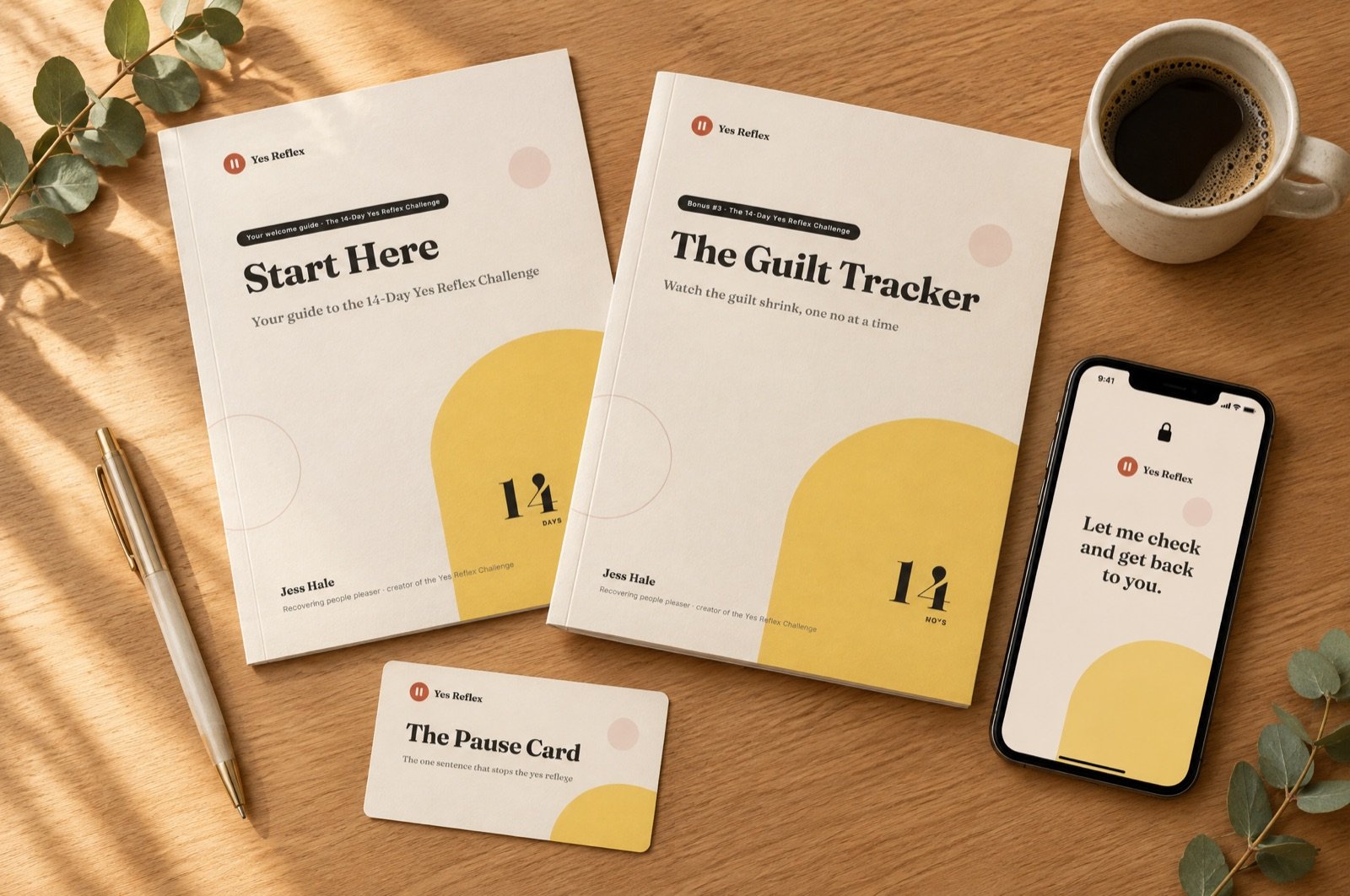
The Start Here guide, the Guilt Tracker, a Pause Card and a phone with the Pause Card lock screen on a kitchen table
Print it or keep it on your phone. Everything arrives on Day 0.

What this isn’t

Not therapy.

It’s practice. If you’re seeing a therapist, it can sit right alongside that.

Not another 300-page book.

You won’t need to finish anything at 2x speed.

Not about cutting people off.

You’ll still help people. You’ll just choose when.

Not a video course for “someday.”

It lands in your inbox. Five minutes. Done.

What it costs

Courses on people pleasing usually run around $200, and coaching can be over $1,000. The 14-Day Yes Reflex Challenge is $23, once. No subscription, nothing that renews. That’s about what I used to spend on the office birthday cake nobody else would buy. And the four bonuses, which sell for $55 on their own, come free with it.

Or look at what the automatic yes costs you now: another weekend that isn’t yours, another holiday season of hosting, another 11 p.m. email that “only takes a minute.”

The 14-Day Yes Reflex Challenge

Five minutes a day. One tiny action. The exact words.

  • 14 daily emails + welcome (Day 0) and wrap-up (Day 15)16 emails
  • Start Here guide7 pages
  • The No Scripts PackFREE! Value: $19
  • The Pause CardFREE! Value: $9
  • The Guilt TrackerFREE! Value: $12
  • What Do I Actually Want? workbookFREE! Value: $15

4 bonuses worth $55 if bought separately, free with the challenge.

$23one-time payment · no subscription
Start the 14-day challenge

Secure checkout · Instant access · 30-day “First Free Evening” guarantee

What happens after you click

You check out securely. Within a few minutes your welcome email arrives with the Start Here guide and all four bonuses. Your Day 1 email lands the next morning. The PDFs are yours to keep, and every email stays in your inbox.

30day guarantee

The “First Free Evening” guarantee

Do the challenge. If within 30 days you don’t have at least one evening back, one you’d have given away before, email me and you’ll get every cent back. No forms, no questions, no guilt trip.

(I of all people won’t make you feel bad for saying no.)


Your next yes is already on its way

Someone’s going to ask you for something this week. Probably today. And the holidays are coming, which is when the asks pile up.

You can do what you’ve always done: say yes before you’ve read the whole message, then spend the evening wondering where your evening went.

Or you can try one small sentence, “Let me check and get back to you,” and see what happens.

A woman at an evening pottery class, laughing as she holds up the bowl she made

Months after my first no, a friend asked Lily to borrow her favorite sweater. She said, “Let me think about it.” Then she said no. I never gave her a talk about it. She just watched me practice.

— Jess

P.S. You don’t have to be brave for this. Day 1 is a five-minute look at your calendar. Day 5 is saying no to a store. By the time you get to the big ones, you’ll have had plenty of practice.

Questions

Won’t saying no make me selfish or mean?

No. The challenge teaches a kind no: calm, short and honest. You’ll still help people. The difference is that you’ll choose when, instead of the alarm choosing for you.

I’ve read the books. I’ve even done therapy. Why would this work?

Books explain the problem. This makes you practice it, one small step a day. If you already understand why you say yes, you’re the perfect person for this: you’re ready for the doing part.

What if people get upset, or I lose friends?

Some people who are used to your automatic yes might be surprised at first. Days 7, 12 and 13 cover exactly that: the awkward silence, what to say when they push back, and what to do with the guilt afterward.

I don’t have time for another course.

Each email takes under five minutes, and each action fits into a normal day. The whole point is to give you time back.

My family expects me to always help. Will this still work?

Yes. Nothing here asks you to cut anyone off. Day 8 is all about “yes, but”: giving the part you actually want to give, so you can stay generous without running on empty.

What if I miss a day, or say yes anyway?

Then you’re doing it right. It’s practice, not a test. Pick up with the next email; there’s no falling behind.

How do I get it?

Right after checkout you get a welcome email with the guide and all four bonuses as PDFs. Then one email every morning for 14 days. Reply to any of them; every reply is read by a real person.

Is this for men too?

It’s written by a woman, mostly with women’s examples. The method works the same for anyone.

Is Jess a real person?

Jess is a composite character. Her story is built from hundreds of real stories people pleasers have shared online, and she’s the voice of the challenge. The method, the scripts and the tools are all real.

What if this isn’t really people pleasing?

If you’re afraid of someone’s reaction because of threats, control or violence, that isn’t people pleasing, and a 14-day challenge is the wrong tool. Please talk to a professional, or call the National Domestic Violence Hotline at 1-800-799-7233 (or text START to 88788). In an emergency, call 911.

Start the 14-day challenge $23

One-time payment · Instant access · 30-day guarantee

Yes Reflex Challenge$23 · 30-day guarantee
Start today