You can’t out-think a reflex. You can out-practice it.
Think of the alarm as a smoke detector that goes off every time you make toast. You don’t rip it off the ceiling. You learn to notice: oh, that’s the alarm, not a fire. Then you keep making toast until it calms down.
That’s the whole method. Three steps:
Step 1
Pause
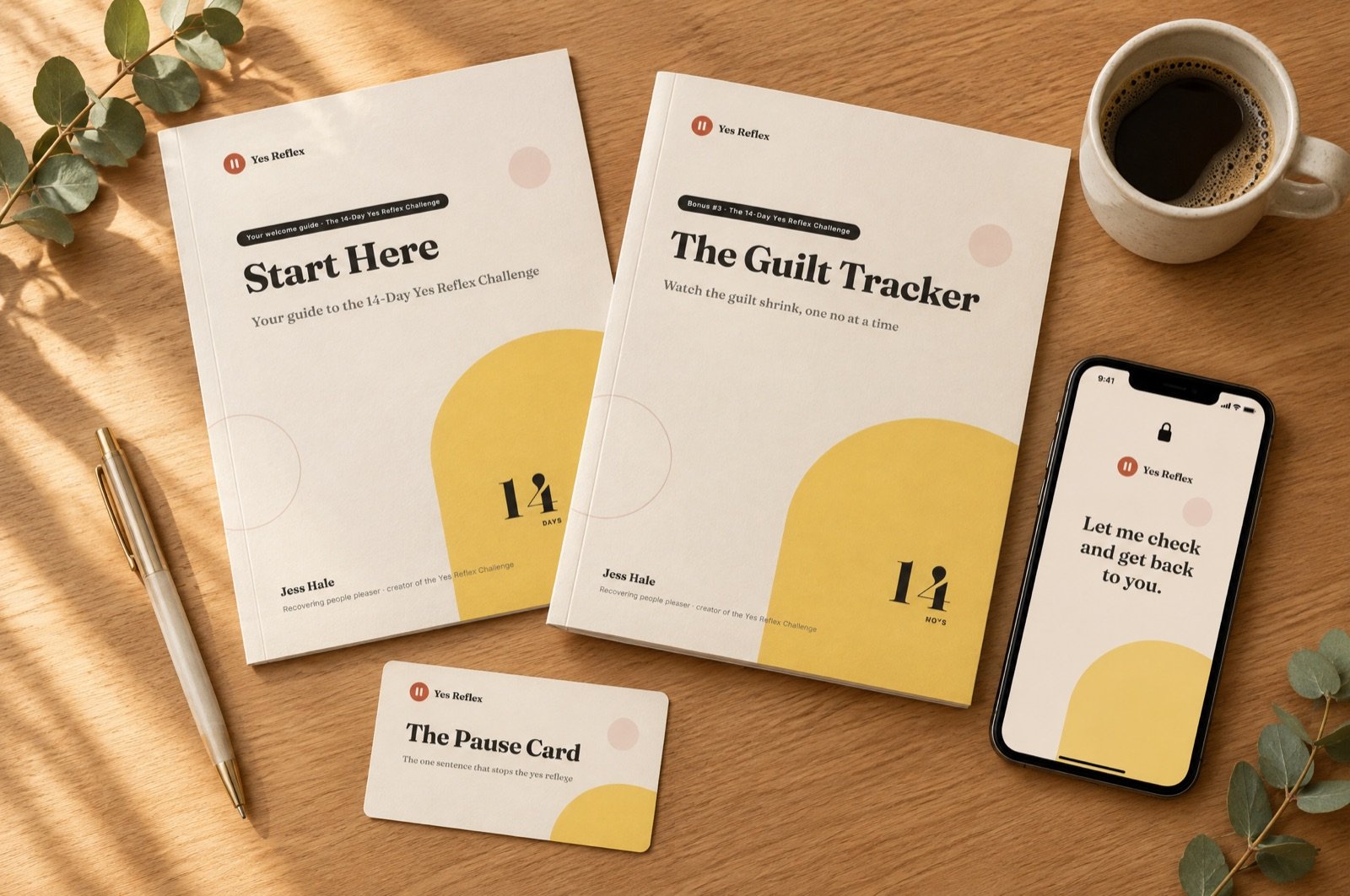
Put a new automatic sentence in the gap where the yes used to go: Let me check and get back to you.
The Pause isn’t a no. It’s a not-yet. That’s a much smaller step, which is exactly why it works when “just say no” doesn’t.
Step 2
Check
Ask yourself three questions. Do I want to? Do I have room (time, energy, money)? What am I saying no to if I say yes?
Step 3
Answer
Then choose: yes, “yes, but” (the part you actually want to give), or no. All three are allowed. The only thing we’re retiring is the automatic yes.
Let me check and get back to you.
You never have to answer on the spot.
1 · PAUSESay the sentence. Breathe out.
2 · CHECKDo I want to? Do I have room? What am I saying no to if I say yes?
3 · ANSWERYes · Yes, but… · No
The Pause Card, front and back. You get it as a lock screen, a desk card and four wallet cards.
Then you practice. Not on your mother first. On an upsell at the register, a survey, a newsletter. My first logged no was turning down an add-on at checkout, and my guilt was a 4. (This is a woman who once bought a $14 phone case because the cashier looked like he was having a rough day.)
Small no’s teach the alarm that nothing terrible happens. Then you work up: a one-sentence no to a friend, a capacity question at work, a family no you’ve prepared in advance.
The first time I tried it at work, my boss sent a “Q3 numbers for Monday” email at 4:55 on a Friday. Instead of my usual “No problem!”, I asked which should move.
Me Happy to. Which should move: the vendor report or the Q3 numbers?
Rick Good call, push the report to next week.
Four minutes later.
I’d spent eleven years assuming he’d be annoyed.
The year I told my mom I wasn’t hosting Thanksgiving, my guilt was a 9. She went quiet, said “Well, okay,” and hung up. The next day she called to ask what she should bring to my sister’s.
9Guilt right after
→
3The next morning
I needed to see that written down before I believed it. That’s what the Guilt Tracker is for.
Not a new idea. Just rarely this small.
Learning to speak up through small, repeated practice is what researchers call assertiveness training, and it’s been tested in randomized controlled trials. A meta-analysis of 12 of them found it reduced social anxiety, with a medium-sized effect.1 This challenge isn’t therapy, and it wasn’t part of those studies. But it’s built on the same idea: skills get stronger with reps, not reading.
And you’re far from alone. In a 2024 YouGov survey, 48% of American adults called themselves people pleasers, and more than half of them said they often struggle to say no.2